
The Night Cage is a cooperative journey through a dark and ever changing maze of nightmares. In this horror-themed tile placement and exploration game, players must work together to find escape while avoiding monsters and outracing their fading candles.
Like the passages that fade into the gloom, hope flickers and fades. Will darkness become your eternal home, forever a part of The Night Cage?
Player Count: 1-4 players
Ages: 14+
Playtime: 50 minutes
GAME PLAY:
Players begin by taking a player status card, a colored candle/prisoner token, a starting tile, and a nerve token. Then, the board is set out and the tile draw pile is put together. Depending on player count, a different number of tiles will be shuffled and placed on top of the tile deck as their starting tiles. The tiles are housed in the tile holder, which looks like a melting candle.
The tile draw stack represents the shrinking candles that players use to navigate the maze. When the draw stack runs out, so do the players’ chances of escape. An empty tile deck triggers an endgame march to defeat.
Players will each place their starting tile on an empty board space and then put their prisoner/candle token on the space as well. A vital piece of gameplay is lighting and revealing spaces on the board. A player with a lit candle will light the tiles directly connected to them by passages. This means players will also start with up to two lit up passages surrounding their starting tile. The board works as a continuous looping maze, so instead of the outside spaces acting as borders, they should treat the tile on the opposite side as adjacent. This matters for both player movement and which spaces are lit.
They players move, they will light up new spaces, but they will also stop illuminating spaces they move away from. If another player is not lighting a space as you move away from them, the tile will fade away and be removed from the board. If someone returns towards that direction, a new tile will be placed. The maze is ever shifting and changing.
On their turn, players have the choice to either stay or move. If they stay, they will gain a nerve token, but they will also discard a tile from the top of the draw pile. They better hope they didn’t lose anything important. However, if a monster would be discarded this way, it instead replaces a space connected to the current player’s tile. Staying will also trigger a crumbling tile if the player is standing on one, dropping them into the darkness.


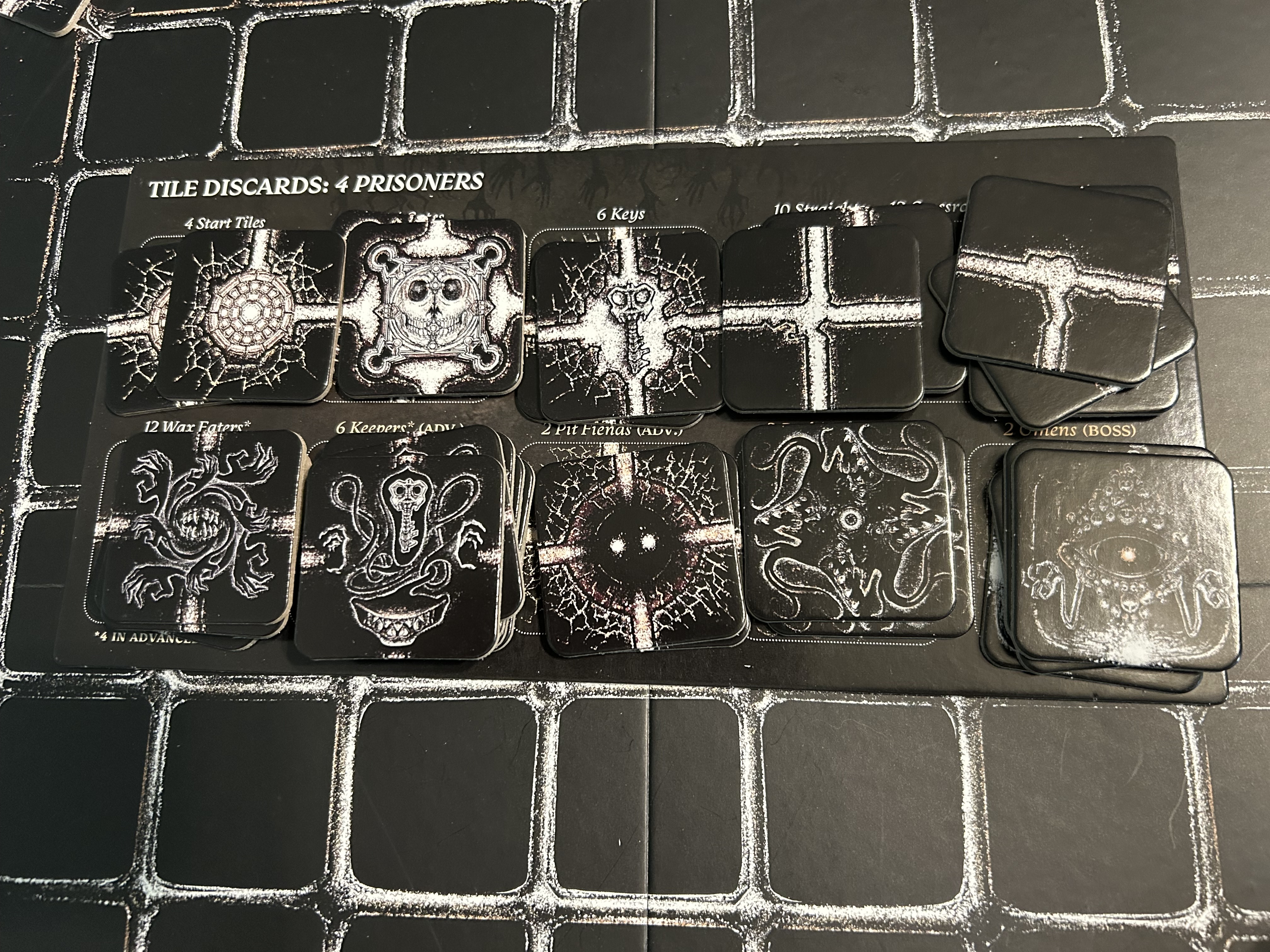
If the player decides to move, they will illuminate new spaces and remove any that are no longer lit. When a new space is illuminated, a tile is drawn from the tile deck and attached to the player’s current tile. The active player gets to choose how the new tile is oriented and attached to their tile.
It’s important to note, that only one player can occupy any tile, except for the gate tile which can house any number of players.
As they venture through the darkness, players will uncover different types of tiles. Passage way come in different shapes, but they are paths for players to navigate normally. They will also come across crumbling tiles which may be moved onto, but if a player doesn’t move off it their next turn, they will fall into the darkness.
A fall into the darkness simply means the player disappears until their next turn where they fall onto a new tile which can be placed anywhere along the row or column where the player previously stood. While this might be an interesting way to travel, players should beware of falling onto monsters or the tile deck running out.
The path to victory will come by discovering keys and getting them to gates. Each player can only hold one key, though they can pass them off to each other. Becare though, if a key is lost to the darkness, it’s gone. Run out of too many keys and it’s game over. The same is true of the escape gates as well. If all four are discarded to the dark, the players will have no way of escaping, and the game is a loss.
There are things that go bump in the dark, and those monsters are wax eaters. Wax eaters are placed like any other tile, and they are motion sensitive. If a player moves into or out of a row or column with a wax eater, they trigger the beast. Once the movement is complete, the wax eater will attack anything in its row or column (though it can be blocked by deadends and missing tiles). And, if a wax eater hits another wax eater, it’ll trigger that one to go off too. A cascade of attacks may quickly befall any unfortunate players.
If a player gets attacked by a wax eater, the top three tiles of the draw deck are discarded and that player’s light goes out. Now, they must navigate blindly. One the tile they stand on is illuminated, meaning they will lose any tile they step off of, unless another player keeps it lit. They may step right into a monster or risk losing important tiles. Also, anyone with an unlit candle must move every turn.
Don’t worry, players’ candles can be relit if they end up adjacent to another player with a lit candle.


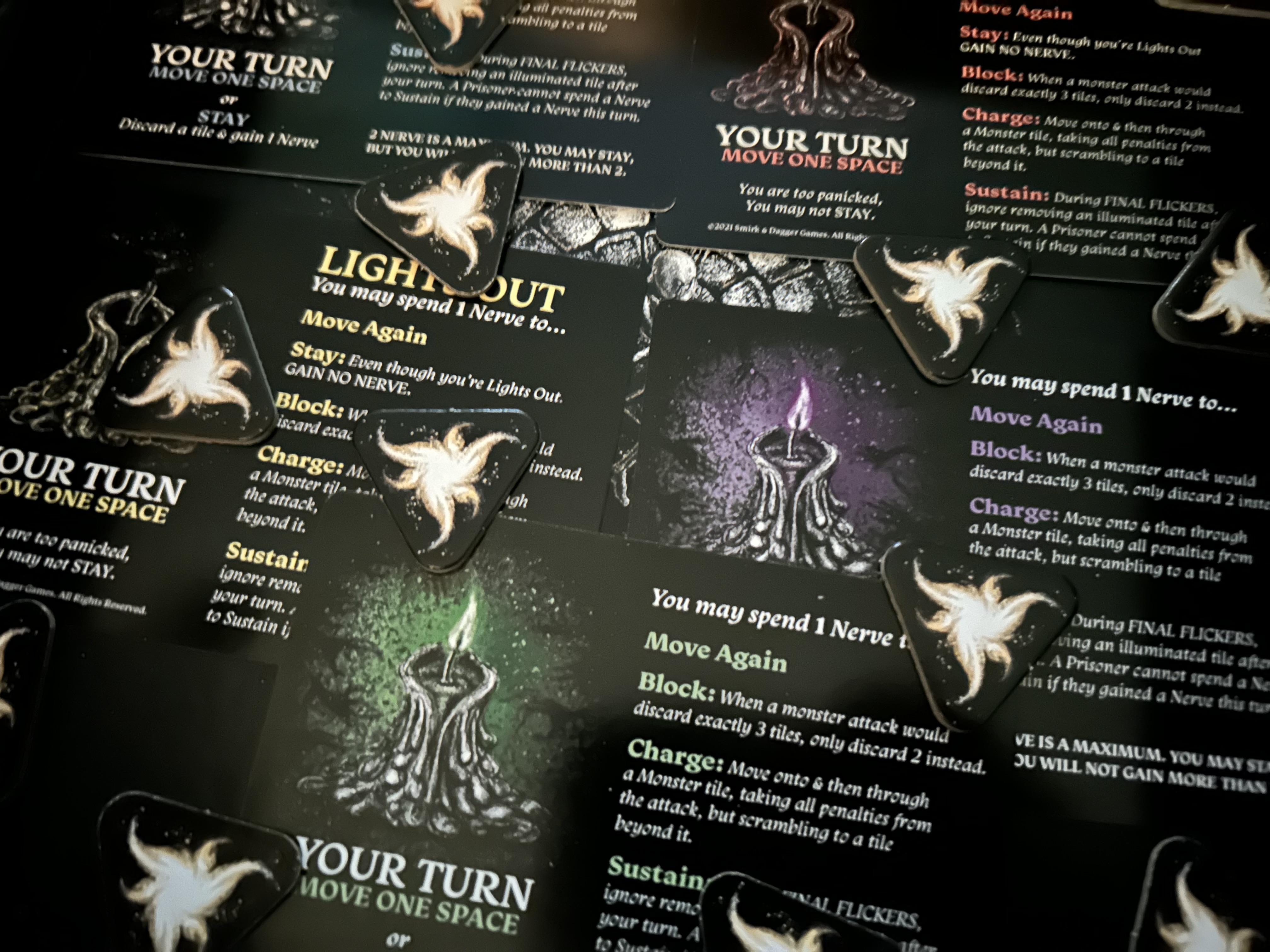
The nerve tokens mentioned earlier, can be used for a few different abilities. Nerve tokens can be used for an extra movement, to discard one fewer tile after a monster attack, to stay in place with an unlit candle, charging into a monster’s space, or holding off tile loss during final flickers.
Players win when everyone meets up on a single gate, each with their own key. There are many paths to loss, but the big one is running out of tiles in the draw deck. At that point, no new tiles are placed and areas are still de-illuminated as normal, however an extra tile is also removed from the board at the end of every turn. Players get a few final desperate gasps before the darkness consumes them.
Can you find escape together, or will you be alone in the dark forever?
OUR THOUGHTS:
The Night Cage does an excellent job of capturing the tension and atmospheric look of the players’ perilous predicament. Every decision feels like it matters during this battle against dwindling time.
The gameplay is quick and smooth, but that doesn’t mean that the challenge level isn’t high. Victory will come through a mix of luck and careful strategy. Despite being lost in the dark alone, this game takes teamwork if players want any chance at success.
The random tile drawing and shifting maze provides a good bit of variability to gameplay, but the core of the experience stays the same. However, if players really want to shake up their experience, an advanced mode with different ways of collecting keys and new monsters provide some fun twist on gameplay.
Overall, The Night Cage isn’t the deepest gameplay experience, but provides a memorable play session through the (fun) stress it brings.
FINAL RECOMMENDATIONS:
The Night Cage is perfect for those seeking a very challenging cooperative experience, and who are okay with randomness of tile reveals dictating just how possible or impossible victory may be. If you’re okay strategizing around and through difficulty, making the best of a rough situation, this is going to be a satisfying game for you, even if you might lose a fair bit. The Night Cage is a horror-themed cooperative game that is brings stress and pressure in an awesome way.





 Chaos & Confetti
Leave a reply to chaosyconfetti Cancel reply